

Updated: Oct 16
Sugar selection at a glance | Eight ingredients
Sugar | Best-use scenario | Suitable products | Flavor profile | Functional effects |
White sugar | Neutral sweetening | Tea, fruit drinks, jam, cakes | Clean and mild | Sweetness, moisture and crystal control |
Golden sugar (No. 2) | Tea syrup, sweet soups | Black tea, milk tea, pearl syrup | Light cane aroma | Subtle flavor and golden hue |
Black sugar | Bold dark-flavor recipes | Black sugar boba, milk drinks, sauces | Rich cane and caramel notes | Color, aroma and syrup cling |
Brown / yellow sugar | Baking and desserts | Cookies, cakes, sweet soups | Gentle molasses notes | Color, moisture and flavor |
Rock sugar | Slow simmering | Sweet soups, tea, stews | Clean sucrose after dissolving | Large crystals dissolve slowly |
Fructose | High-sweetness cold drinks | Iced fruit tea, juice, ice cream | Pronounced sweet taste | Sweetness and freezing-point effects |
Maltose / maltose syrup | Viscosity, crystallization | Candy, pastries, fillings | Mild and less sweet | Gloss, viscosity and texture |
Molasses | Dark baked goods and sauces | Gingerbread, dark cake, sauces | Deep cane and toasted notes | Dark color, flavor and moisture |
White sugar, Taiwanese golden sugar, black sugar and rock sugar often share one major molecule: sucrose. Their flavor and appearance differ because of refining, molasses handling and crystallization. Fructose and maltose introduce different chemistry—and that chemistry affects drinks, boba, jam, ice cream and baked goods far beyond sweetness.
The short answer: three reasons sugars behave differently
Molecular identity: sucrose, fructose and maltose are distinct sugars; commercial syrups are often mixtures.
Processing: centrifugation, removal or reintroduction of molasses and crystal growth change color, texture and flavor.
Formulation: sugar also controls water activity, viscosity, freezing point, browning and moisture retention.
Process map: how one sucrose source leads to different products
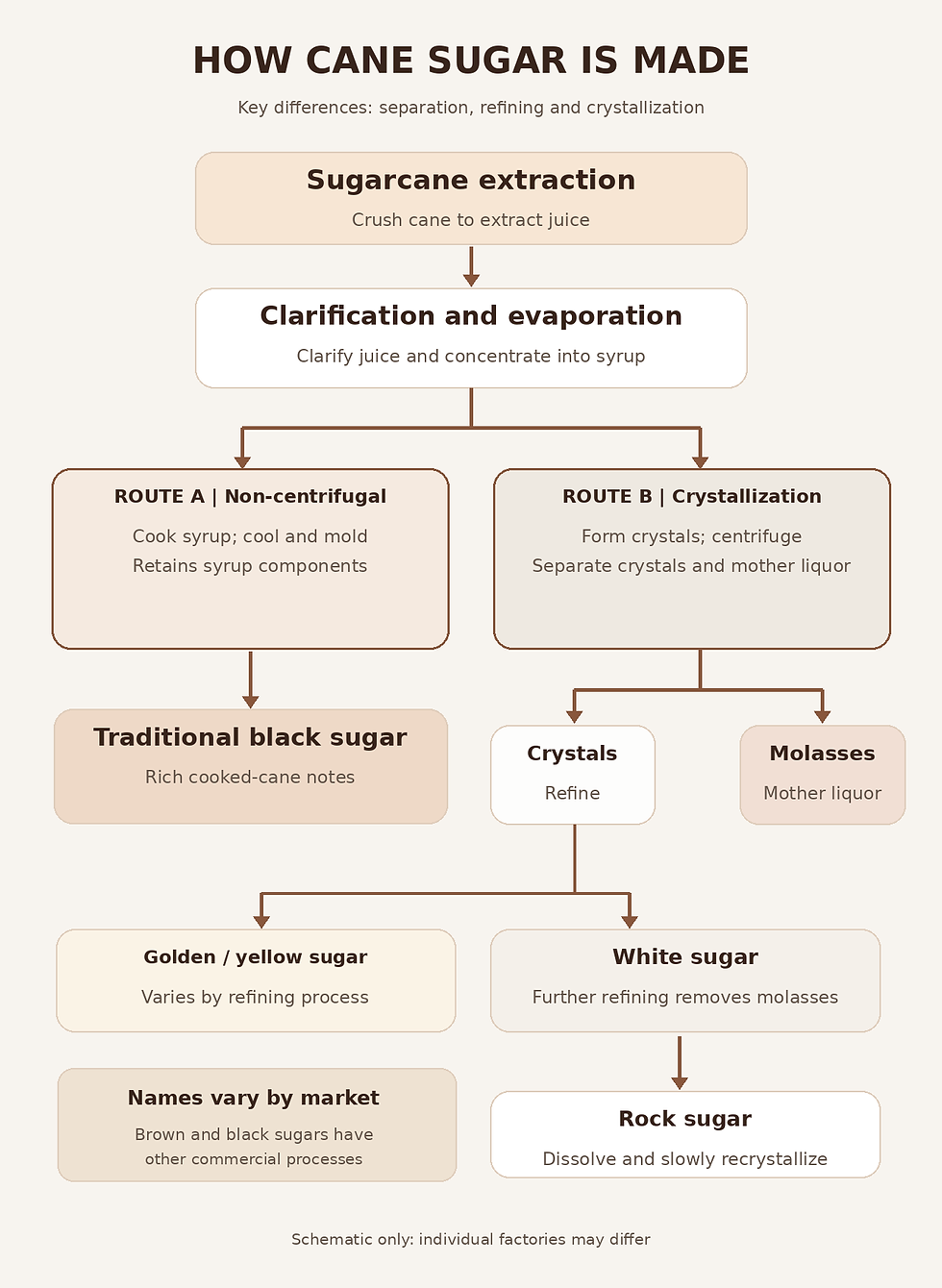
Sugarcane juice is extracted, clarified and concentrated; sugar beets follow a different extraction route. Controlled crystallization followed by centrifugation separates sugar crystals from mother liquor. Additional refining produces white sugar; dissolution and slow recrystallization make larger rock-sugar crystals. Traditional non-centrifugal cane sugar follows a separate boiling route. Molasses is the liquid by-product, not another name for black sugar.
Eight common sweeteners: composition, manufacture and function
Ingredient | Main composition | Manufacturing route | Practical properties |
White sugar | Sucrose | Clarification, decolorization, crystallization, centrifugation and refining | Neutral sweetness; suitable for tea, fruit products, jam and most baked goods. |
Golden sugar (Taiwanese No. 2) | Mostly sucrose | Crystallization and centrifugation; degree of refining varies | Golden color and mild cane notes. Domestic and refined golden sugar are made differently. |
Black sugar | Sucrose plus retained syrup components | Traditional direct cane-juice boiling; other industrial formulations also exist | Strong cooked-cane notes, ideal for black sugar boba and syrup. |
Brown / yellow sugar | Mostly sucrose | Partly refined, molasses retained or molasses added back | The market names are not universal; moisture and molasses determine baking behavior. |
Rock sugar | Sucrose | Dissolution followed by slow recrystallization into large crystals | Slower to dissolve; after dissolution its sweetness per gram is that of sucrose. |
Fructose | Fructose; fructose syrups may be blends | Enzymatic conversion of starch-derived sugars; crystalline fructose requires purification | Relatively sweet, temperature-dependent; useful in cold drinks and frozen desserts. |
Maltose / maltose syrup | Maltose; syrup contains mixed saccharides | Starch liquefaction and enzymatic saccharification | Useful for shine, viscosity and crystallization control; properties depend on sugar profile. |
Molasses | Mixed sugars and non-sugar solids | Mother liquor after sucrose crystals are removed | Dark, intensely flavored by-product for gingerbread, sauces and dark sugar notes. |
Four distinctions buyers should know
Taiwanese No. 2 golden sugar is sold in both locally produced and refined versions; the routes are not identical.
Brown, yellow and black sugar names are not internationally standardized. Verify moisture, composition and manufacturing method.
Fully dissolved rock sugar has essentially the same sweetness per gram as equivalent sucrose; crystal size mainly changes dissolution.
Commercial fructose and maltose syrups may contain multiple sugars rather than a single pure molecule.
The other manufacturing family: starch-derived sweeteners
Corn, tapioca and other starches undergo liquefaction and enzymatic saccharification. Different conditions produce maltose-rich syrups; further isomerization may increase the fructose fraction in selected starch-derived syrups. Sweetness and viscosity depend on actual carbohydrate composition and solids.
Five applications: what sugar changes in the finished food
Beverages: balance sweetness with tea aroma
Refined white sugar offers neutral sweetness; golden sugar adds subtle cane notes. Fructose-containing syrups are easy to dose in cold drinks, but sweetness varies with composition and temperature. Black sugar and molasses suit signature drinks rather than delicate teas.
Boba: coating is not the same as chewiness
Black sugar syrup increases color and aroma while concentrated syrup affects gloss and cling. Tapioca pearls' elastic bite mainly comes from starch selection, gelatinization, cooling and storage. Switching sugar alone will not reliably fix chewy texture.
Jam: sugar must work with pectin, acid and water activity
Sugar contributes soluble solids and supports conventional high-sugar pectin gels. Different syrups influence crystallization and texture according to their carbohydrate composition. Lower-sugar jams require a redesigned gelling system and validated water activity, pH, heat treatment and packaging.
Ice cream: sweetness and freezing-point control are different
At equal mass, fructose generally depresses the freezing point more than sucrose. Too much may make the frozen dessert overly sweet or soft, so total solids and texture must be balanced.
Baking: aeration, moisture and browning
White sugar is versatile for consistent aeration and color. Brown sugars and molasses add moisture and deep flavor. Reducing sugars such as fructose take part in Maillard reactions with amino compounds; sucrose itself is not a reducing sugar.
Four specifications to check before switching sugar
Brix or total soluble solids, so syrup prices and doses are compared fairly.
Carbohydrate composition: sucrose purity, fructose fraction, maltose content.
Physical attributes: moisture, color, flavor, viscosity, crystal size and dissolution.
Finished-product targets: tea aroma, pearl coating, jam safety, ice-cream firmness and bakery structure.
Conclusion: the right sugar is the one that serves the formula
Sugar selection is product engineering, not only sweetness selection. Miboba works across beverage, dessert, frozen and bakery ingredients, where the best approach is to define the target sensory profile and processing conditions before choosing a sweetener system.


Comments